
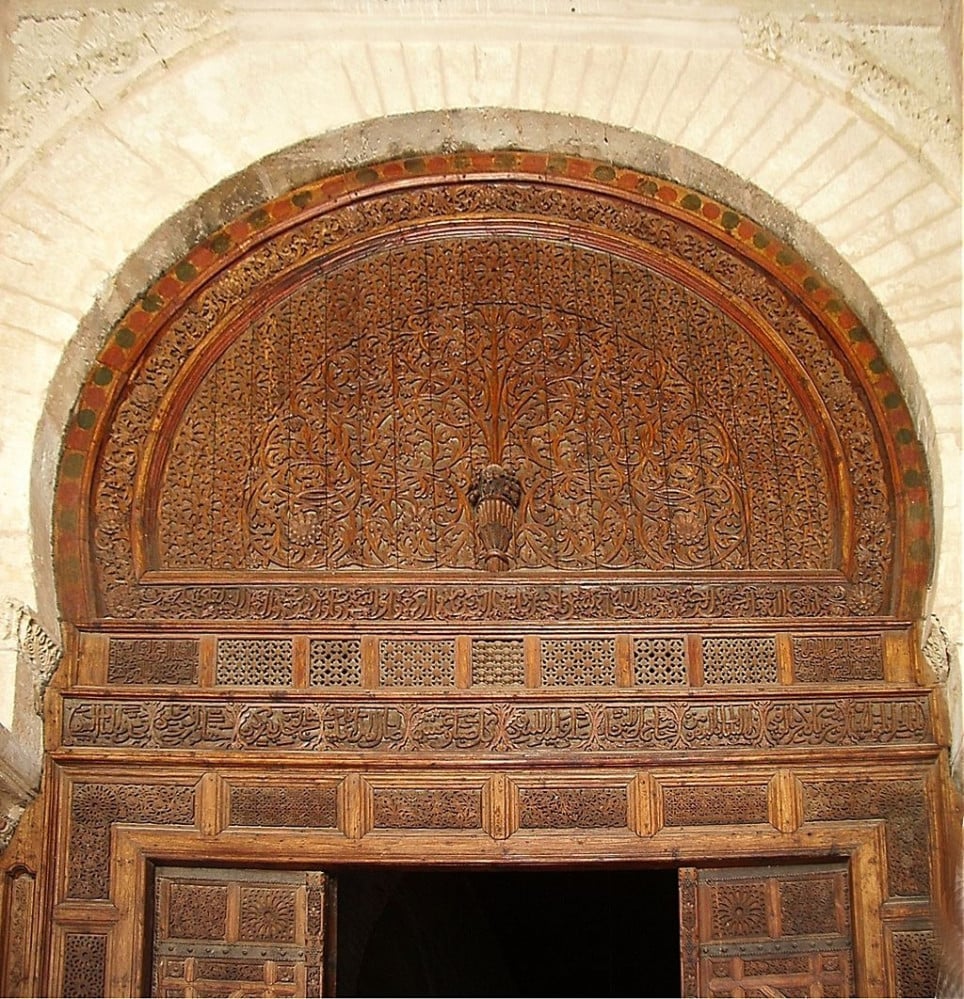
The art of carving on wood or the art of Ouima (the word Uima means carving inscriptions and drawings on wood), is a group of craft arts carried out by skilled hands to transform wood into beautiful art. The art of carving on wood is considered one of the oldest arts in history. Humans started with it since ancient times, and the Ottomans decorated it Different buildings with wooden parts, whether it is carving on wood, engraving on it or coloring it; Such as mosque pulpits, boxes, Quran holders, clothing boxes, safes, and chairs. The art of carving on wood was also used to form beautiful geometric drawings.
At the present time, “Al-Owaimah” is associated with furniture, so most of the Al-Oimajia workshops are in places where furniture makers gather, such as: the coastal cities of Damietta and some areas inside Cairo; Such as Al-Gamaleya - Weapons Market - Abdeen - Imbaba - Al-Zawiya Al-Hamra - and Al-Basatin. Whoever works in this profession is called “Oemji.” This art is not new, as it has existed since ancient times. Pharaonic, Roman, Greek and Sumerian temples, and among the most famous countries famous in the modern era for this art are Italy, Cyprus and Damascus in the Syrian Arab Republic. Damietta in the Arab Republic of Egypt is distinguished from others, as most of the population works in this craft as part of the carpentry craft, and one of the most important hand tools for those who work in this craft.
Tools used in excavation
old tools
Such as a wooden hammer, the chisel of all sizes, the jacquard, the brino, the rattle, the pterygium of all sizes, the Japanese knife (scalpel), the file, the planer, and the smoothing tools.
A set of wood carving tools
Modern gadgets
They are electric tools for drilling on wood that save time and effort. Recently, some semi-automatic and automatic tools have appeared, such as the slashing Uima machine, the router, and the computer-operated machine to produce the latest masters. The Uima is currently used in all types of furniture, and you can find it abundantly in salon sets, dining rooms, bedrooms, sofas, and all wooden antiques.
Embroider oriental engraving on wood
Oriental drill models are called drill strings. These threads began as recesses, then quickly developed with time and became a combination of recessed and protruding together. They are as follows:
Kayseri
The tsarist style was widespread in the past, but today it is less made, and in it the handles and the sieves dominate, and these nibbles are full and some are empty and are usually, between them bars confined in circular and oval shapes, and these bars are double and single empty, and they are used in making boxes The old ones that were presented with the bride’s device, and are now used in frames, some clutches, and center tables (the salon).
Arabi
The wooden artifacts from this thread prove the extent to which this industry was affected by the Byzantine and Sasanian arts, and this is evident in: the wooden fillings that were found in Al-Aqsa Mosque, which includes many plant decorations, including acanthus leaves, the Jews' thorn, the triangular plant leaves, and grape leaves.
It can be worked with iron, copper, or wood, and it has braided geometric shapes. This thread dates back to the days of the Umayyads, when it was found on the interior doors of the Umayyad mosques. In general, all the ancient buildings of Damascus dating back to this date are characterized by this type. The shapes of these threads, called in Arabic, are geometric, including the quintile, the hexagon, the hexagon... and the shapes of the spider and the nest of the crutch bee. Ibn Tumart Preparatory High School
Abbasi
The Hellenistic and Sasanian styles continued and then developed into a new style invented by the Muslims in Iraq, known as the "Third Samarra Style".
The Abbasid carving is similar to the Ayyubid in terms of the absence of animals, and the wood carving in it is ghal (palm) and is used for all pieces of home furniture. It is the simplicity of construction, the beauty of composition and the speed of implementation. Its engravings often take the form of almonds, and are interspersed with simple floral motifs lined regularly, longitudinally or circularly, depending on the piece of wood. This engraving is suitable for making a main complete piece called the Abbasid filling.
Ayoubi
The same styles that prevailed in the Fatimid era continued, except that the artist increased the number of decorative units executed on the masterpiece, and it is characterized by the emergence of the Naskh script along with the Kufic script.
However, the Ayyubid works are distinguished from the Fatimid ones in the absence of images of animals, and it is also like the Fatimid two types, hollow and non-hollow, and its decorations are in plant shapes, especially the grape leaf, and shells may be used with it in the makhraq (where the floor of the void is filled with shells). The Ayyubid drilling in Damascus represented all the previous arts.
Fatimid
The artistic style of making and decorating wooden artifacts at the beginning of the Fatimid period represented a transition between the styles that were used in the Tulunid and Ikhshidid eras, which were derived from the style of Samarra. After that, a great development took place in this style, as the decorations became executed in a more fluid way, and most of them depended on plant leaves. wavy.
Many of the modern buildings these days have decorated their windows with Arab and Fatimid threads, which are of two types, hollow and non-hollow, and the latter appears as if the carvings in it are pasted on a wooden floor and are used for frames and wall decorations or salon sets and all pieces of furniture. In the Fatimid color, the shapes are multiplied, but the eye is comfortable with this multiplicity, which is often a hexagon or a star with Quranic verses in the wooded Kufic script. The Muslim artist excelled in engraving plant branches, tree leaves, human and animal drawings, and this appears in the pillars of Sultan Qalawun.
Noureddine
Artists during the era of Nur al-Din added simple shapes such as wooden columns carved in a spiral.
Mamluk
The wooden artifacts industry developed greatly in the Mamluk era, due to the flourishing of urban activity during this period, so it was necessary to pay attention to wooden artifacts to supplement the needs of the facilities such as windows, doors, roofs and mashrabiyas, as well as what mosques need in terms of chairs, Quran boxes, pulpits, niches and ceilings. Therefore, the carpenters developed The methods of industry and decoration, as well as the development of decorative units such as the star plate, which reached its peak of prosperity in that era, as well as among the most famous decorative units are the “collected fillings” and they excelled in inlaying them with ivory, shells, and zircane.
Andalusian
Persian
Types of flat drilling
The types of carvings on natural wood in traditional crafts are divided as follows:
Punching and perforating The craftsman hollows out the wood in the form of different panels that represent drawings of specific plants and flowers, animals and birds, or verses and wisdom.
Wooden turning This craft relies on the ability of the manufacturer to adapt the wooden pieces well with a manual lathe, thus producing pastry molds, dice, chess, hookah heads, wooden chair structures, etc... It has recently turned into automated production. A special market was established for this craft in Damascus, which is the Al-Kharatin Market.
Vaccination
It depends on highlighting the symmetry in the shapes drawn by inlaying the wood with various materials such as shells, bone, tin, copper and even silver, by digging precise lines that represent the required drawings, then filling them with the required material. In this way, craftsmen produce mosaic boxes, jewelry boxes, luxurious offices, tables, chairs, and tables. picture frames, and more.
Downloading on wood quoted from mosaic works in the Byzantine era, different from the art of engraving, and Damascus knew its resurgence almost a century ago when craftsman George Bitar saw the masterpieces of mosaics in the Umayyad Mosque and quoted its idea trying to apply it to wood with mosaics. Wood can be downloaded - such as lemon wood, bitter orange, and roses - Or bone or shell in colors contrasting with the color of the engraved wood, so the delicate geometric decorations and cursive writings appear in the perforated bone material or the shell material with a charming appearance.
Types of stereoscopic drilling
Flat relief engraving, in which the height of the engraved motifs reaches about 5 mm. It is often used in the design of medals and Islamic engravings.
The problematic excavation , in which the height of the engraved motifs and figures on the floor increases by more than half 0.5 cm and reaches about 7 cm in the Roman excavations, provided that the floors in the form are all equal and of one depth.
The embossed embossed carving is like the shaped embossed carving, but it is more prominent and deeper in the floors, which must be equal in depth as well. The heights of the engraved decorations may reach a frame of 25 cm to give a stronger effect. This type of carving is suitable for use in places far from sight. Organisms.
Hollow excavation , which is the excavation of hollow formations with the jigsaw and excavated at the same time, provided that its units hold together, and it is used in the works of precious frames. The empty chandeliers are used in the official halls. In general, there are many drawings of animals such as deer, horses, lions, and wild beasts in this style, but their shapes are incomplete.
Muqarnas is a kind of decoration developed by the Arabs, and it became one of the features of their art, and it has multiple images, some of which resemble stalactites hanging from some caves, and some of which resemble ant nests or beehives, and the origin of the muqarnas is the niche that is used to move from the square to the level on which the dome is built In buildings distinguished by their domes. Currently, this art is limited to decorations that can be hung from the ceilings, such as lighting centers and places to hang chandeliers, or the sides of large comfortable seats, or the edges of tables and tables, or windows in fixed windows in the walls, and others. The Syrian Arabs inherited this art from other nations that preceded them, and developed a lot in it until it became what it is of renewal and innovation.
Recessed excavation is the opposite of the prominent excavation of the previous types, in which the engraved decorations are inward while leaving the floors as they are without excavation or engraving.
Stereoscopic engraving , which is the most accurate type of engraving, and includes engraving on blocks with the intention of shaping and embodying them. It is most used in sculpture and making statues.
Types of wood used in drilling and their characteristics
The wood used in drilling varies in terms of its use and ability to form, some of which are fused or open-fiber, and some are knotty, cracked, twistable, or moisture-resistant. It is also characterized by its flexibility, the beauty of its tan, or its ability to be polished
natural timber
The most important of these woods:
American and Turkish walnut wood , which is characterized by the beauty of its fibers and flexible hardness, and is considered one of the most valuable woods and the most suitable for accurate drilling due to the merging and accumulation of its fibers and its inability to crack.
Oak wood is light in color, has beautiful features, is characterized by strength with its flexibility and the accumulation of its fibers, withstands weather fluctuations, can be smoothed and polished, and is an ideal wood for strong and bold designs and fine details. It is golden in color and has good-looking grains.
Mahogany wood is solid, rich in veins, its color is close to red, and its fibers are generally straight. It is one of the best hardwoods that expands and does not shrink. It can be carved gently and has the ability to crack.
Olive wood is excellent for carving and has a dark, greenish-brown color that is suitable for fine detail work.
Poplar wood is soft, but it is not easy to cut, as it appears from its effect on tools when used, as it needs pressure and thus becomes blunt quickly. Its color ranges from cream to light green when freshly cut. It is good for consumption and use, as it is susceptible to shocks and scratches.
White pine wood is light in color with many knots and cracks. It is soft and it is not recommended to use it for drilling.
Ebony wood , which is one of the hardest woods, has a black color and is widely used in inlays and ruler edges.
Beech wood combines hardness and ductility, and it is one of the most used woods in carving and furniture because it is easy to work with, suitable for shaping, with integrated fibers, and its color is light brown.
Musky wood is light in color, free of knots, cracks, and warping, and its use in drilling is well limited.
Dear wood is soft and resinous, one of the finest woods for its good tanning and moisture resistance.
Industrial timber
- Plexiglas (opposite) is called that because it reverses the direction of its fibers and has different thicknesses.
- Slutax wood.
- particleboard wood.
- MDF wood.
Wood carvings recently in the Arab world
Egypt
In the last fifty years, several figures became famous in Egypt, each of whom represented a distinct trend in the art of uima, such as (Saeed Abdel Halim - Marzouk - Mahmoud al-Maghribi and others in Cairo and Damietta). ...in Cairo and the countless artists of Damietta and its workshops and factories that elevated this art, such as: Al-Iraqi - Shulah - Abu Samra - Attia and others). Uima arts have a distinct sense of the drama of painting, mass, and space, and their experience was characterized by daring in using the forms of nature in furniture, such as the sculptor / Sami Al-Ghobashi .. in Cairo, who has several experiences and participation in the plastic art movement in Egypt in the field of sculpture, in addition to his writings about the art of Uima and theorizing it in the Egyptian press And Arabic, in addition to his bold experience in employing unfamiliar forms from nature in the manufacture of furniture, and his peers in this art - Adel Imam - Essam Ibrahim - Ali Al-Habbak - - and many others who left a deep artistic imprint in this art. For an ancient who is not without a house of it
Syria and the Levant
The Damascene mosaic industry is one of the oldest professions for which the city of Damascus is still famous. It is the art of inlaying wood with mother-of-pearl, or what is called mosaic. It is the introduction of mother-of-pearl into particles of different types of wood, where the wood is spread into small sticks that form a bundle of types and colors. Different pieces are cut into slices that are combined together to form the required shape, and that the history of the mosaic industry dates back to more than 700 years, when this profession was famous during the days of the Turks. The launch, and the Damascene mosaic has become like the ambassador who preceded the politicians to most countries of the world, where the salon furniture occupies the palace of the President of the French Republic and the palace of the President of the Republic of Mexico, the Damascene mosaic, in addition to the Gulf palaces that are filled with Damascene mosaic. [5]
Morocco
The art of engraving on wood in Morocco is considered one of the high-end and original creative arts that many of its cities are famous for, as it is inspired by its artistic and aesthetic characteristics from very ancient arts and civilizations.
It is remarkable that the Moroccans are still so far preserving such ancient arts and taking them as elegant decorations in their homes, in addition to spreading them in a number of palaces, luxury hotels, restaurants and shrines.
The industry of these arts flourishes greatly in the summer, with the events of organizing weddings and the return of immigrants from abroad, because foreign tourists accept a lot of their products, especially the light ones, such as decorations, accessories, and others.
The Hassan II Mosque located in the city of Casablanca, which is among the largest Islamic monuments in the world, is truly a large and distinctive Islamic beacon overflowing with decorations from various artistic and architectural creations, including wood carvings created by the most skilled artists in Morocco and the Islamic world.