
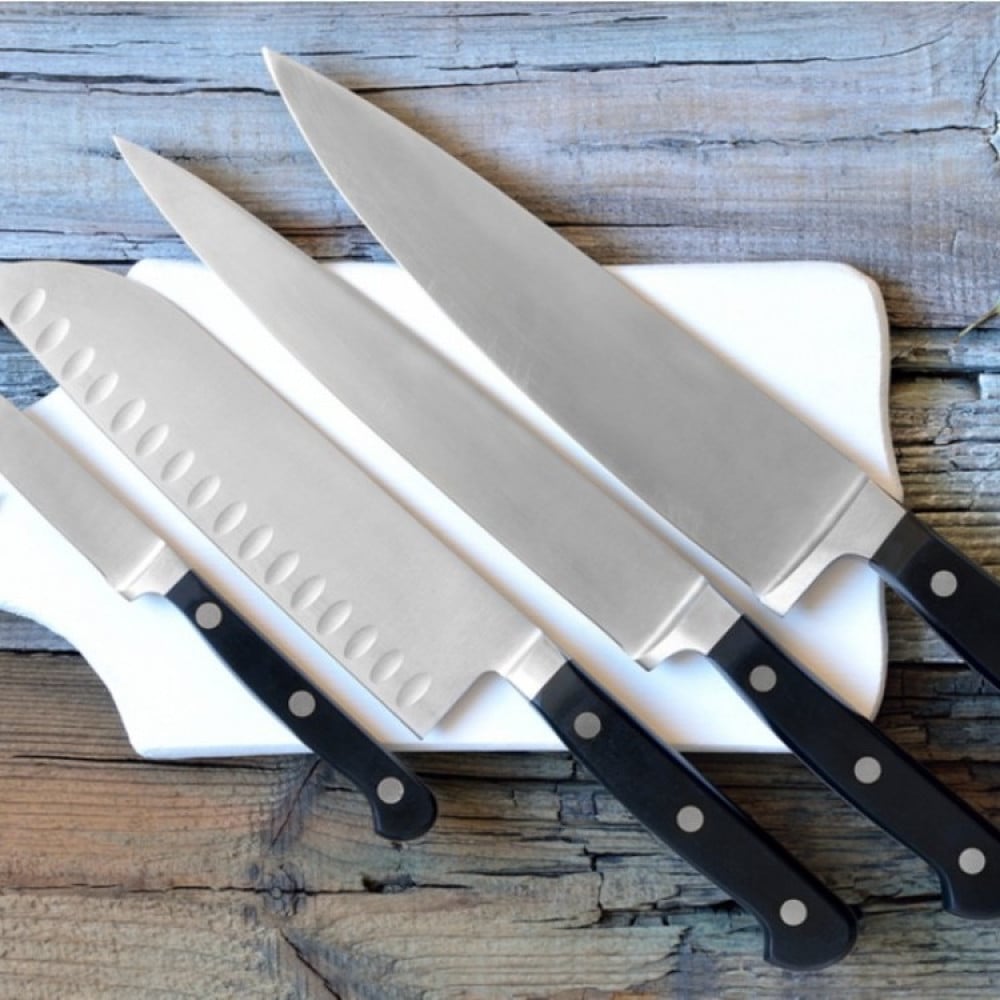
It is true that the history of the knife is an integral part of the history of kitchen utensils around the world, but it is also an integral part of the history of civilization, progress and technical development that humanity has witnessed since ancient times. Recent excavations indicate that the beginnings of using this important tool date back to before Homo sapiens, ie at least 3 million years ago.
Because of this long history, some consider the knife to be one of the most important technologies in the history of mankind at all, as it enabled humans from the beginning to interact with the world around them, change this world, and manipulate it by ascending to the top of the food chain, hunting, planting and harvesting to building cities and others. In other words, it can be said that the knife is one of the tools that enabled the emergence of the world of technology, the world of armies, wars, culture, science, and the world we currently live in.
The Jabal Al-Araki Pharaonic knife is one of the oldest, most beautiful and famous knives in the world. The date of this knife , made of flint and engraved elephant ivory, dates back to 3450 BC, i.e. the days of the second Naqdi civilization. Describing the knife that was found in the oldest city of ancient Egypt, the city of Abydos, the French linguist and Egyptologist Georges Haroun Panedetti, who bought it for the Louvre Museum in 1914, says, "It is an ancient knife with a wonderfully beautiful ivory handle." It is a masterpiece of sculpture that dates back to before the ruling dynasties. It was made with remarkable ingenuity and elegance. This is a work of amazing detail. There is a hunting scene on one side, and on the other side a scene of war or a raid.”
There is no doubt that the use of polished and sharp stone knives with handles of wood, bone and ivory, which the ancient Egyptians were known for, is the second technical or qualitative shift historically after the initial and primitive uses of cavemen that relied on serrated stones and sharp seashells.
What was applicable to the knife and stone in the past, was applicable to most cooking utensils.
However, the third and important shift in the history of the knife did not occur until the beginning of the discovery and harnessing of metals in West Asia 3000 years BC, when people began producing knives made of metals. It all started with copper.
Before the Bronze Age, knives were decorated with feathers and animal skin, and they were a source of great pride for warriors and tribal elders. With the advent of the Bronze Age, after learning about the means of combining tin and copper, we began to see bronze swords and knives in some parts of Asia and Europe. Although this type of knife was more durable than other materials, it needed continuous sharpening, which led to the development of sharpening methods and techniques that people knew later. The sharpness and design of the knife in this era is one of the things that attract its acquisition.
The iron knife that we are currently using did not see the light until after the advent of the Iron Age and the monopoly of the Hittites in the mountains of Anatolia and the Fertile Crescent to use iron in their manufacture of weapons and swords. Iron and steel entered the world of the knife through its wide doors, and did not leave it until now.
There is no doubt that the ability to harness and develop iron gave the Hittites and Philistines military superiority over their enemies of the Babylonians, Egyptians and Hebrews, but the high quality of iron and its techniques came through the people of Greece, Alexander the Great and his famous sword.
In conclusion, it was very important for people to obtain a strong and durable material that could maintain its shape and limbs at the time, and a qualitative leap in the primitive worlds of manufacturing.
However, the transition from the military and bloody use of iron-making techniques to domestic and kitchen use did not occur until later in France, Germany and Japan (these countries were influenced by each other in the manufacture of the modern chef's knife ).
These countries were among the most important major centers for the manufacture of excellent swords, and from the same factories and foundries in the German cities of Solingen and the Japanese cities of Seki, came the modern and advanced chef's knife .
Iron-making techniques in Solingen, Germany, date back two thousand years, as indicated by recent archaeological excavations. However, the world of the knife and its manufacture and production on a large and modern scale did not begin until the beginning of the 18th century with the products of Peter Henckels factories of household appliances, especially the knife .
The first modern German chef's knives were strong, large, sharp, and curved-bladed for slicing, unlike Japanese and French ones designed for slicing.
Although Japan is rich in iron and coal and is very well known for its high technologies in the world of iron and swords for centuries, and that katana swords or samurai swords are an integral part of its culture and history, the spread of the modern knife did not happen except with the arrival of the Portuguese and the start of tobacco cultivation, when they began to manufacture Special knives for cutting tobacco plant. The transformation of many workshops and foundries from making swords to making knives at the end of the 19th century, after the prohibition of carrying katana or samurai swords, helped spread the manufacture of knives on a large scale until we reached the most famous current knives, or what is known as the “gyoto” knife and the knife «Santoku» pit belly.
There are, of course, many types of kitchen knives , such as a regular kitchen knife, a bread knife that is usually serrated appropriately for slicing, a meat cleaver, a butcher's knife, a bone cleaver , a short oyster knife, and a traditional table knife.
In the Middle Ages, knives were made with handles of ivory and bone, and they had pointed heads capable of stitching and cutting. They were also few, and people were proud of their use during banquets.
It must be mentioned here that the role of the knife in Europe from a tool for cutting and preparing food, especially meat, to a tool for eating and an integral part of the basic cutlery did not happen except in the Middle Ages and among the people of the upper classes. Carrying a knife in the 15th century was restricted to individuals who were prohibited from carrying weapons. Knives were also sold as sets of hunting knives and kitchen knives, and this did not change except with the disappearance of hunting life and the spread of civilian life. And then the knife began to appear next to the spoon, and then to the side of the spoon and fork.
Before the 17th century, royal families and the upper classes of European societies used to use knives made of silver, and later gold. And these families began to put their engraved seals on these knives.
- In the first American colonies, the colonists in general looked suspiciously at kitchen knives, so they were used little, and those sitting at the table sometimes shared their use. People used to hold the spoon in the left hand and the knife in the right hand to cut the meat until they changed their habit and started using the spoon in the right hand as is the case now. And later, the new Americans began to abandon the serrated-headed knives that hunters wanted, to the blunt-headed knives, a tradition started by the French Cardinal Armand Jean Richelieu in the mid-seventeenth century, and therefore many researchers consider him the spiritual father of the modern table knife. It is known that Richelieu was the one who advised King Louis the 14th to issue a law prohibiting sharp, pointed knives on the table and in the street, to reduce violence in society at the end of the seventeenth century. While some believe that Richelieu, like Confucius, believed that sharp knives provoke violence and wars, the story says that his decision against sharp knives came after the then Minister of Finance, Pierre Seguier, used the knife on the table that they collected at his home as a stick for pickling and cleaning teeth. This behavior was prevalent among the people of the upper classes, as it was difficult for them to separate the function of the knife as a tool for cutting, and as a tool for stitching, cleaning, digging, killing, and so on.
But some say that the entry of the fork into the main cutlery line at the time is what led to the decline in the popularity of the pointed knife, as the fork replaced the knife as a sharp tool with a greater ability to stab and pick up pieces of food. In other words, the fork found its place and identity in the series of household, kitchen and tableware tools, after the knife played its role for many centuries.
From the short personal knife to the long-bladed table knife and from stone to iron, the knife evolved and accompanied man on his long journey and adapted to it, to the extent that it spread and became an integral part of modern and cheap plastic tools that can be found everywhere.
Corky knives
Maharaja Padma Rana, who was the Prime Minister of Nepal in the 1940s, says in describing the kurki knife, “The kurki is the national and religious weapon of the Gurkhas (soldiers of Nepal), and the Gurkha should carry it while awake and put it under the pillow after retirement.” In other words, it is difficult to separate kyuki and jurkhi as they are two sides of the same coin.
This knife, which can be used like a sword, is one of the most effective knives in terms of cutting, throwing and slashing. The Nepalese used it at home, in planting, harvesting, opening cans, skinning animals, logging, digging, etc., and most importantly in fighting operations and eliminating the enemy with one blow, as it enables its owner to inflict severe damage on his opponent because of the curved blade shape.
The fame of the knife, which is a national knife and a symbol of the intrepid Nepalese soldier, began during the days of the British in India, and attempts to suppress rebellious movements there, in the early nineteenth century. However, the history of this effective and deadly knife, which is used in various rituals and popular ceremonies, seems to be much longer and dates back to more than 2500 years, which makes it one of the oldest known knives in the world. The available information indicates that the shape of the unique blade of the knife is descended from the shape of the Greek sword, which was known as the “Al-Kubis” sword, and that the shape of the Korki knife is very similar to the shape of the Macedonian cavalry sword known as the “Mushaira”. It is the sword that the horsemen and soldiers of Alexander the Great carried with them when they invaded northwestern India in the fourth century BC. It seems that the blacksmiths in Nepal were inspired by this form and worked through the ages to develop what suits their needs throughout the ages. The shape of the Greek sword also goes back to the shape of the Pharaonic sword known as “Khopesh”, a model of which was found in the tomb of Tutankhamun, and before it the Assyrian sword “Spara”.