
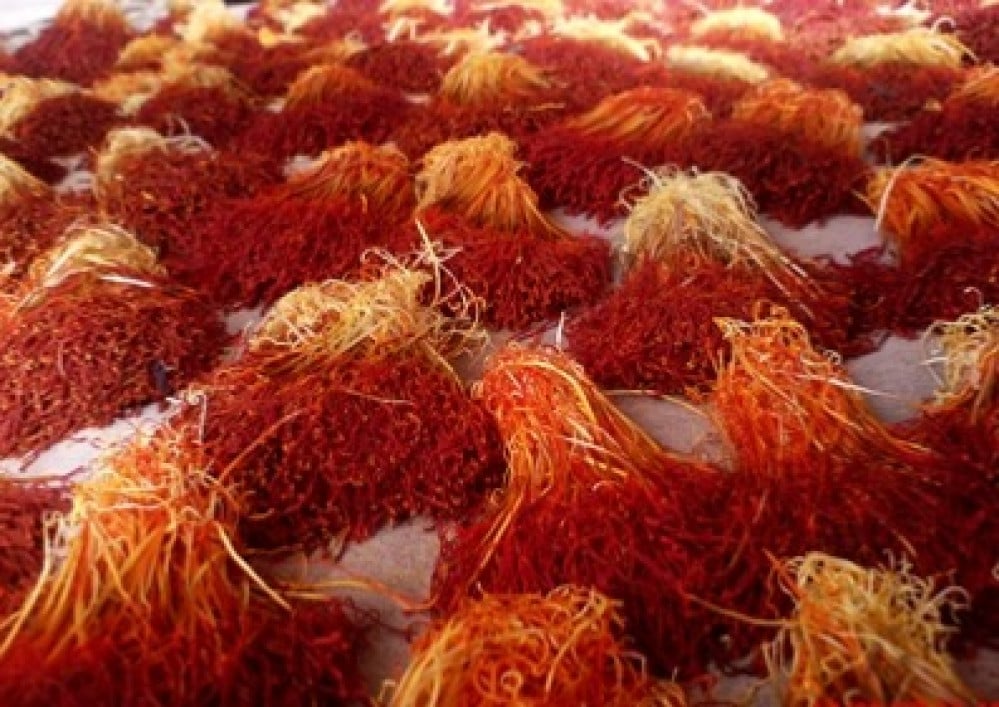
Saffron or hoss is a bright yellow dye that adds a good flavor to food. It is produced by drying the stigmas and part of the stigmas in the flower of the autumn violet saffron plant, scientifically known as Crocus sativus.
Approximately 4,000 flowers can produce about 28g of commercial saffron. The stigmas are removed from the open flowers, dried in the shade and then on a fine or fine net over low heat. This substance is red-orange in color and has a pungent odor and distinctive taste. It is kept in sealed containers so as not to lose its value as a precious substance.
Saffron smells good, but tastes bitter. It is used in cooking to give food a good flavor. It is also used in coloring desserts. People in Europe and India use it to season types of food.
Medical uses
The active part in saffron is the stigma of the flower (the pollination organs) that is removed from the open flowers with great precision, and by the hands of people with experience and art in picking and assembling them. And dried in the shade and then on a fine or fine mesh on low heat. The stigmas contain a volatile fatty oil with an aromatic scent and colored substances. This substance is red-orange in color, with a pungent odor and a distinctive taste. It is preserved in court times so as not to lose its value as a valuable material. But today, with the spread of medicines, it no longer has a great medical value, and this is apart from the fact that many originally doubted that it had a medical benefit. Therefore, its use as a medicine has become limited to popular circles. Saffron is used as a herbal medicine for carminative (spasms and flatulence). Medieval Arabs used saffron to treat respiratory infections and disorders such as coughs, colds, scarlet fever, smallpox, cancer, hypoxia, and asthma. Other targets of saffron included blood disorders, insomnia, paralysis, heart disease, stomach disorders, gout, and bleeding. Chronic uterine and eye disorders. And the ancient Egyptians used it as an aphrodisiac. Methanol prevents saffron determination at high rates. This occurs by strong proton donation ppph by the two active saffron saffron and so on at concentrations of 500 ppm and 1000 crocin studies showed neutralization of 50% and 65% of radicals respectively showing SAFMAL lower rate than crocin, but These properties make saffron extracts used as an antioxidant agent in the field of pharmaceutical products, cosmetics and as a food supplement. Despite all this, saffron is a lethal substance. Numerous studies conducted on laboratory animals have shown that 50D of saffron, or the lethal dose, or a dose of 50%, these animals die from an overdose of 20.7 g / kg. Saffron is also considered an antidepressant
chemically
Pigmentary properties
It contains carotenoid pigments (crocin), which is used as a dye for silk and as a golden yellow food colouring. We need 70,000-80,000 saffron flower stigmas to get 1 kg of saffron, which contains 10g crocin and about 60g crocin which is the actual pigment.
Historical overview
The history of saffron cultivation dates back more than 3,000 years. The wild ancestor of the tamed saffron plant was the "cartraetinaus plant". Ancient farmers bred saffron by selecting plants with long stigmas and then planting them on their farms. Thus emerged the "tame" varieties of saffron during the late Bronze Age in Crete. Experts believe that there are documents talking about saffron dating back to the seventh century BC, as it was discovered as a medicinal drug during the reign of Ashurbanipal. Since that time, saffron has been used in medicine to treat more than 90 ailments and often pure saffron stigmas are mixed with the stamens to add still weight. Stamens do not have culinary properties. The saffron powder should be red-orange. Stigmas (stigmas) of pure saffron are often mixed with the stamens to add dead weight. Stamens do not have culinary properties. . The saffron powder should be red-orange.
Trade and use of saffron
Saffron has been used in perfumery and medicine for more than 3000 years. It is the most expensive spice in the world. It is composed of stigmas. It is characterized by good taste and quality. Saffron is found in southwest Asia, but it was first cultivated in Greece. Iran is considered one of the largest producers of it in the Middle Ages and the modern era as well. It is used in Africa, Asia and Europe in cooking and drinking. Saffron is used in the field of medicine to treat abdominal pain, and it is also used to color materials. Saffron cultivation was centered in the regions near Europe, southwest Kashmir and in northeastern Asia. The most saffron-producing countries in ancient times were Iran, Spain, India, Greece, and then it spread all over the world. The cultivation of saffron in America began with members of the Schwenkfelder Church in Pennsylvania.
modern trade
Large cultivation areas
Large manufacturing areas
Small farming areas
Small manufacturing areas
— a major trading center (current)
— a major trading center (historic)
Saffron cultivation patterns in the world:
- producing areas
- major producing countries
- secondary producing areas
- secondary producing countries
- Major commercial centers (current)
- Major (historic) trading centers
The production of saffron theoretically in the geographical regions started from the countries of the Mediterranean Sea (the countries of the west to the east of Kashmir), all the continents outside this area except Antarctica (Antarctica) are considered saffron-producing countries. The world produces saffron about 300 tons annually in the form of leaves and powder, as it produced about 50 tons of saffron in 1991. Iran, Spain, India, Greece, Morocco, and Italy are considered among the countries that produce the most saffron (about 80%). As Afghanistan entered the field of saffron production recently. Saffron is made from stigmas and some roses that help dry it. For example, in Kashmir, thousands of farmers work and make great efforts for a week or two to produce saffron for us, which we use in our homes day and night.
Saffron threads (stigmas are red in color) mixed with stilettos (yellow) from Iran
Saffron (red stigmas and other yellow components) Its components are derived from Iran, and it is a herb that resembles honey, but it bears a little bit of bitterness. Handmade herbal medicine. Saffron is the most used material in cooking, science, and medicine, and the most productive countries in Asia are India, Kashmir, and even the Mediterranean countries.
The use of saffron in cooking
Saffron cake
Saffron is widely used in some Arab countries such as Morocco, Egypt, Iraq, Syria, Yemen and some Asian cuisines. Al-Khaira described its aroma as honey with grass, metallic straw. The taste of saffron is such that of straw. With reference to its bitterness. Saffron also contributes its yellow-orange color to the food coloring. Where saffron is used in baked goods, cheese, sweets, curries, spirits, meat dishes and soups, saffron is used in India, Iran, Spain and other countries as a seasoning for rice, saffron rice is used in many foods, as it is used in many famous dishes Such as: paella valenciana, which is the preparation of rice and meat with spices, as well as the zarzuela fish dish, which is cooked fish, and it is also used in (fabada asturiana) and saffron is essential in the French dish (bouillabaisse), which is a spicy fish mixture from Marseille. As well as (risotto) Italian rice food based on saffron and Swedish varieties and Korkesh of saffron cake.
Swedish saffron cake
Saffron cake in Sweden lussekatt (literally cat Lucy after Lucy Saint) or lussebulle is commonly consumed before Christmas. It is a rich yeast in cookie dough flavored with saffron, cinnamon or nutmeg. Cakes and baked goods are in many traditional shapes, the simplest of which is shapes and are usually eaten during Advent, especially on Saint Lucy's Day on December 13 in England. The traditional cake is baked on sycamore leaves with powdered sugar.
Enjoy the cake "revel bun" is a name for a cake in the Cornwall region that is baked for special occasions such as anniversaries or dedications to the church and cornwall buns which are also known as "tea treat buns" and are associated with Methodist Sunday school outings and activities
Spanish paella dish
.
Saffron is one of the three basic ingredients in the Spanish city (paella valenciana) and is responsible for the yellow color. Saffron is used in the national dish (chelow kabab), while the Uzbeks use it in the rice dish known as ("wedding plov"), and the Moroccans use it in their dishes, i.e. tagine, including In that meat with tomatoes, which is called kofta, as well as a dish of kebabs and chicken, and mrouzia, which is lamb with peaches and almonds, saffron is also used in the chermoula herb mixture, so Moroccan dishes have many flavors. dependent on milk.
.
Because of its high cost, saffron diluted with safflower or turmeric was often used, as the color of saffron was well imitated, but with completely different flavors from saffron. Saffron is also used in confectionery and alcoholic beverages and this is most commonly used in Italy: blue liqueurs rely on saffron to provide color and flavour.
Medicinal use of saffron
Saffron is used as a herbal medicine for carminative (cramps and flatulence) and emmenagogue (enhancing blood flow in menstruation). Medieval Europeans used it to treat respiratory infections and disorders such as coughs, colds, scarlet fever, smallpox, cancer, hypoxia, and asthma. Other targets of saffron included blood disorders and insomnia. paralysis, heart disease, stomach disorders, gout, chronic uterine bleeding, and eye disorders. And the ancient Egyptians used it as an aphrodisiac. Methanol prevents saffron determination at high rates. This occurs by strong proton donation ppph by the two active saffron saffron and so on at concentrations of 500 ppm and 1000 crocin studies showed neutralization of 50% and 65% of radicals respectively showing SAFMAL lower rate than crocin, but These properties make saffron extracts used as an antioxidant agent in the field of pharmaceutical products, cosmetics and as a food supplement. Saffron is also considered an antidepressant. Despite all this, saffron is a lethal substance. Numerous studies conducted on laboratory animals have shown that 50D of saffron, the lethal dose, or the 50% dose, these animals die from an overdose of 20.7 g / kg.
Medicinal properties
It is useful in reducing menstruation and relieving menstrual pain and chronic uterine bleeding. It calms intestinal colic and is useful in indigestion, abdominal pain and chest tightness. Its powder stimulates blood circulation and benefits the spleen, liver and heart. It has a substance that lowers blood pressure. Modern medicine does not recognize that saffron is a sexual stimulant and that what was believed in the past is incorrect.
Saffron is considered an antispasmodic that brings pleasure to the heart of those who drink it, a stimulant to the stomach, a strong effect on the intestines and nerves, a stimulant for menstruation, and saffron is included in some medicines used to stimulate the heart and some types of kohl that helps remove cloudiness from the eye. Saffron has been used since ancient times to treat many diseases such as gastroenteritis, as a sedative for stomach disorders, to treat whooping cough and colds, and to relieve stomach gases. Saffron is used in Quranic treatments in writing veins and Quranic verses with a supply of saffron and rose water.
Saffron is included in the manufacture of modern medicines, such as those used to expel intestinal worms, calming medicines for nervous and psychological conditions, medicines used to stimulate urinary secretion, and many other medicines. Research confirms that eating a lot of saffron cracks the head and hypnotizes the senses, so it is advised not to eat too much of it. Chemical analyzes have proven that saffron contains a substance called (rosine), which tastes sweet, and this substance strengthens the nerves, stimulates and stimulates menstruation.
- Boiling one gram of saffron in a liter of water and drinking it after cooling it down is considered a cold drink and a nerve stimulant.
- Saffron oil is an anti-pain and anti-spasmodic, menstrual pain and gingival pain remover.
- An analgesic and tonic for the central nervous system, and it is also useful in cases of impotence.
- Saffron is used as a spice in food preparation.
- It has cancer-fighting protective properties.
And in the latest study published by the specialized Journal of Medicine and Experimental Biology, researchers in Mexico have proven that saffron, a type of plant that is added to food as a seasoning to add flavour, can be used as a preventive agent against cancer or in a treatment program for this disease. And the researchers found, after reviewing a large group of laboratory studies and research conducted on animals, that saffron not only prevents the formation of new cancerous tumors, but it may cause shrinkage and shrinkage of existing tumors, as well as increase the effectiveness of chemotherapy and encourage its anti-cancer effects.
The researchers explained that the health benefits of saffron may be due in part to its high content of compounds known as carotenoids, which also include “lycopene” and “beta-carotene” as cancer prevention and treatment agents . Experts pointed out that growing and harvesting saffron is a very difficult process, so its sources are limited and expensive, noting that this study adds new evidence that some foods and spices contain compounds that have cancer-protective properties. For example, animal studies have shown that rosemary protects against breast cancer, and that turmeric protects against some types of tumors. Studies suggest that eating more fruits and vegetables, especially from the onion family, such as cabbage, broccoli, and cauliflower, may help prevent certain cancerous diseases.
And modern medicine does not recognize that saffron is a sexual stimulant, and that what was believed in the past is incorrect. Kohl helps remove cloudiness from the eye. Saffron is included in the manufacture of modern medicines, such as those used to expel intestinal worms, calming medicines for nervous and psychological conditions, medicines used to stimulate urinary secretion, and many other medicines.
Research confirms that eating a lot of saffron cracks the head and hypnotizes the senses, so it is advised not to eat too much of it. To get one gram of original saffron, one hundred flowers are needed, and to get half a kilo of the same variety, it needs 225 thousand saffron flowers, so the price was exorbitant. Chemical analyzes have proven that saffron contains a substance called rosin (its taste is sweet), and this substance is tonic, stimulant, and helps to induce menstruation for women.
Ibn Sina says in his book Al-Qanun fi al-Tibb about saffron: Its flower resembles the flower of jasmine, some of it is yellow, and some of it tends to white. If it is drunk in the drink, it will benefit from the hot swelling in the ear, it will clear the eyesight, and it will be useful for the cloudiness. It is harmful, but it strengthens the stomach because of its heat, tanning, and astringency. It was said that saffron is good for the spleen, diuretic, and beneficial for the hardening of the uterus and its joining and malignant ulcers in it if it is used in a silage with its weakness.
Al-Khawzi said: It does not change the mixture at all, rather it preserves it on dryness, corrects the putrefaction and strengthens the guts. Adornment: the color improves its drinking. Tumors and pustules: a tumor analyzer and erysipelas. The organs of the head: a headache that hurts the head, and it is drunk with the mists of the muffler, and it is hypnotic, darkening the senses. The organs of the eye: it brightens the eyesight, prevents it from descending into it, benefits from blurring, and wears it for blueness acquired from diseases. Chest organs: a joyful heart tonic. It is smelled by the mubarsim and the owner of the hookah for hypnosis, especially if it is applied, and it facilitates the breath and strengthens the mechanisms of the breath. Food organs: It is nauseating and suppresses the craving by its anti-acidity in the stomach and with it the craving, but it strengthens the stomach and the liver because of what it contains of heat, tanning and astringency. Some people said: Saffron is good for the spleen. The organs of jerk: it irritates the stomach and diuretics, and it is beneficial for the hardness of the uterus and its joining and malignant sores in it if it is used with a mum or wiped with weak oil, and some of them claimed that he watered it in the prolonged labor, and she was born at the hour. Poisons: It was said that three mithqals of it kill with joy. Al-Abadal: A substitute equal to its weight in installments and a quarter of its weight in peeled skin.
Ibn Al-Bitar said: Saffron, if pounded and beaten in the egg yolk, is beneficial for bleeding hemorrhoids, strengthens the viscera, prevents liquid moisture from the eyes, improves skin color, and strengthens the heart.
Colorful and fragrant
Despite its high cost, saffron is used to dye textiles, especially in China and India, but it has an unstable color and the vibrancy of orange-yellow quickly fades to pale yellow, so clothes dyed with saffron were the preserve of noble classes only from the distinctive gowns and robes that were worn by Hindu and Buddhist monks in the centuries In the Middle Ages in Ireland and Scotland, in addition to the monks wearing a linen shirt known as LEIME, it was traditionally dyed with saffron, and there were several attempts to replace the expensive and expensive saffron with cheaper dyeing with the usual saffron substitutes in safflower, food, turmeric, and spices. However, the main constituent saffron was discovered. The color of crocin yields flavonoids in the gardenia fruit, because gardenia is much less expensive than saffron cultivation, and research is currently underway in China as an economical alternative. Saffron was chief in the aromatic substances known as Crocinum, which includes ingredients such as dragon's blood (color), wine (colour), Crocinum fragrance was also applied to the hair and a mixture of saffron and wine was prepared to produce a viscous spray and to be applied to the touch Roman comfort as an air freshener.
grades
Saffron is one of the expensive plants to be cultivated financially, technically and technologically. Therefore, its price has become very expensive, especially the luxurious types of it that are grown in Morocco, as obtaining 500 grams of it requires planting no less than 70,000 flowers , all of which must be correct and valid. Also, fresh saffron, when it is dried, loses a lot of its weight. Twenty-five kilograms of it becomes, after drying, only about five kilograms.
Saffron is adulterated because of its high price by mixing it with herbs similar to it to increase weight, such as safflower, which has a similar color and speed of solubility with water, and is sold as true saffron. And the finest types of saffron with red hair, which does not have yellow at the tips of its hair. The best is the soft, good-coloured, fragrant, thick-haired, almost white at the edges.